|
MENUS! STOREFRONTS!
Guide book STILL Available - Free Downloads Only! In COLOR! |
|
|
|
|
|

This page is in no way to suggest that we are again in the
business of selling Eric Schweig's art. To the contrary, we have added this page
due to constant inquiries and as a bonus to Eric Schweig fans! All quotes from
Eric were made in the past in response to allegations made from other sources!
We have no current information as to where one might purchase one of Eric's art pieces.
Same applies to contact information!
| My relationship with Elaine and Rich is certainly not one based on greed. I've only been carving these masks for about a year now, and I want to sell them. They help me do that. It's a killer Web Site! The only sources of information on my professional career are to be Mohican Press, my Washington Fan Club, Deidre & myself. See you in Florida! I will be bringing a mask with me! ... Eric Schweig, February 3, 1999 |
|
FILM: The Missing (2003) ...... Pesh Chidin The JJ Harper Story (2003) ......Harry Wood Mr. Barrington (2003) ......Samuel Skins (2001) ...... Rudy Yellow Lodge Big Eden (2000) ......Pike Dexter Red River ...... [Napolean] ...... Karukera Productions Tom & Huck ...... [Injun Joe] ...... Painted Fence/Disney Follow The River ...... [Wildcat] ...... Signboard Hill Squanto: A Warrior's Tale ...... [Epenow] ...... Disney Productions The Scarlet Letter ...... [Metacomet] ...... Scarlet Letter Prod. Pontiac Moon ...... [Ernest Ironplume] ...... Dysphunkshonal Films The Last Of The Mohicans ....... [Uncas] ...... 20th Century Fox Chaindance ...... [Featured] ...... Chaindance Productions The Shaman's Source ...... [Robert Crow] ....... Dr. Robert Bouvier TV:
VIDEO:
COMMERCIALS:
THEATRE:
VOICE: Simultaneous to the 18th century clashes between the French, English, and Indian peoples of eastern North America, the Inuit and Aleuts of the western continental coast were being invaded by Eurasians ... the Russians were coming. Resulting from the 1741 explorations of Vitus Behring, a Russian interest in North American furs piqued. Promyshlenniki (fur traders) rushed to the Aleutians seeking otter and seal furs. Thus began the Russian-North American fur trade/colonial period ... and consequently, the destruction of Aleutian and Inuit villages. For the next century, the Inuit and Aleutians suffered degradation, abuse, and tragic decimation at the hands of the Promyshlenniki. Entire villages were forced into labor during the hunting seasons; men, women, and children. When the desired amount of furs were gathered, the majority of traders would return to their homeland ... 'til the next season of the hunt began again. Often they left not only with the prized pelts, but with various cultural articles they "acquired". Among the items taken to Russia were the spirit masks of the native people ...
Only at night he clears the path.
But if he does that with no one watching him - Inuit admonition to perform charitable works for elders quietly, seeking no glory or reward.
|
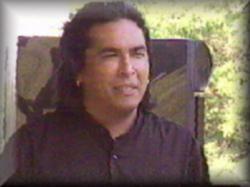
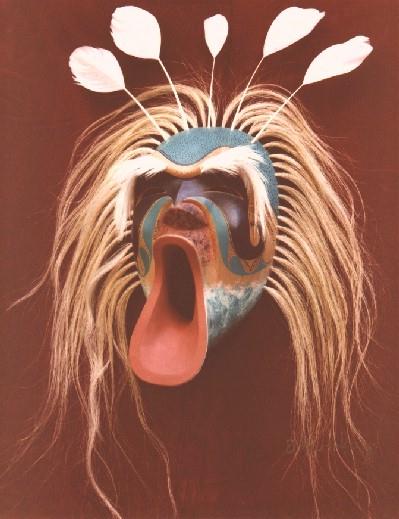
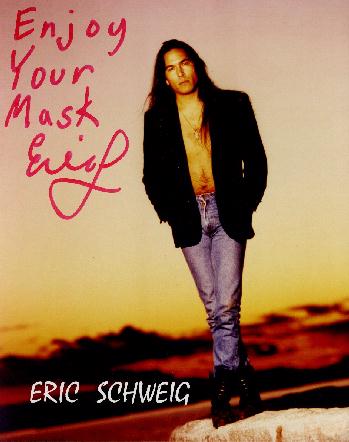
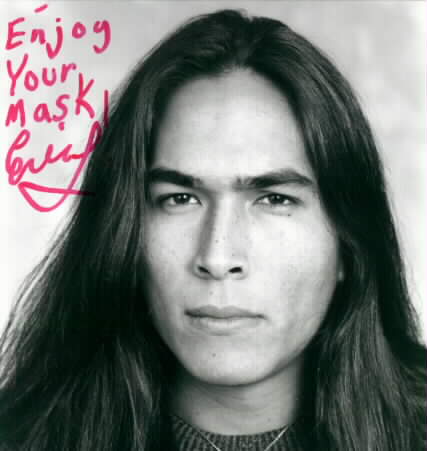
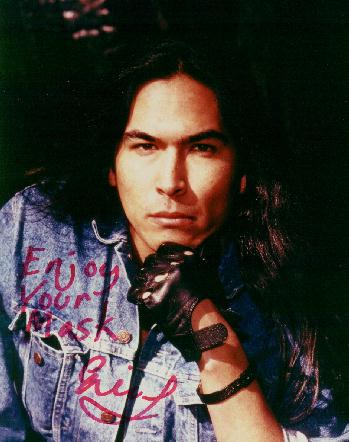
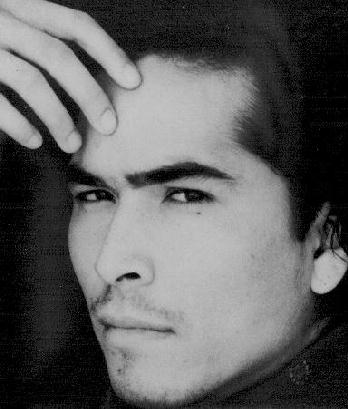
Canadian actor/musician/artisan Eric Schweig has carved in one form or another nearly his entire life. Under the tutelage of notable Tahltan carver Vern Etzerza, he studied traditional Pacific Coast carvings before refining and directing his talent specifically towards the recreation of the traditional Spirit Masks of his own ancestors, the Inuit. Immersing himself in available notes and photographs of various Beringian pieces acquired during the 19th century by Russian ethnographer and "collector" I. G. Voznesenskii, Eric Schweig began carving and recreating the ceremonial masks of his roots. In what has developed into a personal journey of rediscovery of his own cultural heritage, the 32 year old Schweig has accelerated and carried his art to new heights. Corroborating with renowned West Coast painter and master carver Art Thompson of the Coast Salish and Nuu-chah-nulth nations, Schweig has created his own, "intensely personal" series of Adoption Masks. Born from the tragic victimization he experienced at the hands of abusive adoptive parents, the Adoption Masks - titled Inuit Man Screaming - are powerful, expressively carved images of the human spirit; beautifully married elements of aesthetic beauty and vivid expressions of pain. Influenced by the artistic style of Indonesia and inspired by a child’s suffering, the masks are dedicated to all who have been uprooted from their culture and tragically victimized. Born in Inuvik, NWT, Canada on June 19, 1967 to an artistically gifted family of painters and carvers, Eric Schweig was adopted at age six months. After residing six years in Inuvik, the family relocated and finally settled in Toronto. Eric demonstrated both a love and a gift for carving at an early age. It was, says Schweig, "... something that came naturally to me. I’ve been working with wood since I was knee high." As a child, Eric frequently carved Inuit figures, kayaks, knives, guns, and various toys for other children. A source of pleasure in childhood, it was a skill he was to retain and nurture into adulthood. Schweig left home at the age of 16, relying upon his woodworking skills to support himself in Toronto by seeking renovation and framing work. In 1987, while still in Toronto, the 20 year old Schweig was approached by a stranger and encouraged to audition for an upcoming production called The Shaman’s Source. Despite having had no prior acting experience, Schweig decided to audition. He won the role and thus began his film career. He continued to support himself both through Toronto theatre productions and as a musician until the pivotal year 1992 offered new opportunities. In that year, he auditioned for and won the role of "Uncas" in Michael Mann’s film The Last Of The Mohicans. The success of the film and the publicity it generated afforded the actor visibility that opened new doors in the film industry. Schweig went on to star in numerous major film productions. After ten years of film, video, and theatre work, Schweig decided to refocus on his primary, life long art form, carving. Having dedicated himself to the study and carving of Inuit Masks, Schweig has truly excelled in this field. His work is gaining increased attention worldwide and has been sold in Canada, the U.S., Asia, and Europe. |
All images & text are the sole
property of Mohican Press.
Reproduction in any form is prohibited.
Though we are well aware that it
has already been plagiarized, this biography is written by Mohican Press and was
approved by Eric Schweig.
The Art:
CLICK ON IMAGE TO VIEW FULL PHOTO
|
|
|
||
|
|
|
||
|
|
|
||
|
|
|
||
|
|
|
| Regarding the Spirit Masks ...
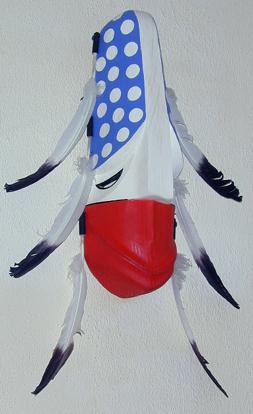
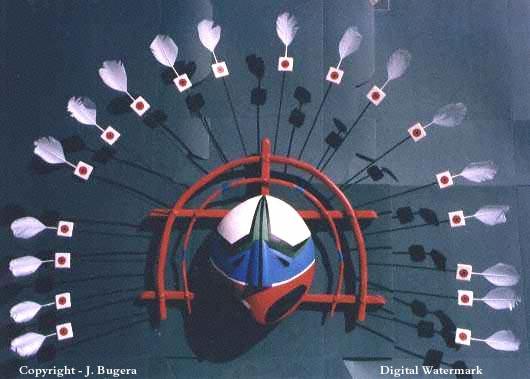
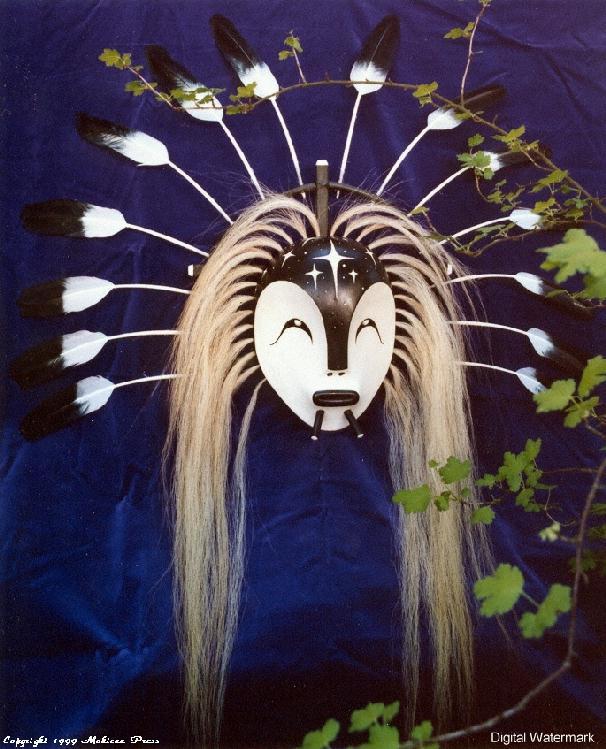
This mask was originally produced by Inuit People indigenous to Kodiak Island, Alaska. The mask was acquired by a Russian explorer by the name of Vosnozenskii, who was part of the onslaught of foreigners who were
using questionable methods to liberate Inuit masks from their makers. By reproducing these masks from the museum photos we are in fact taking them back to where they belong. |
Regarding the
Adoption Masks
...
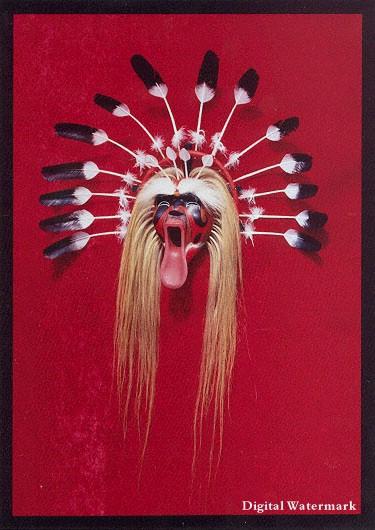
This
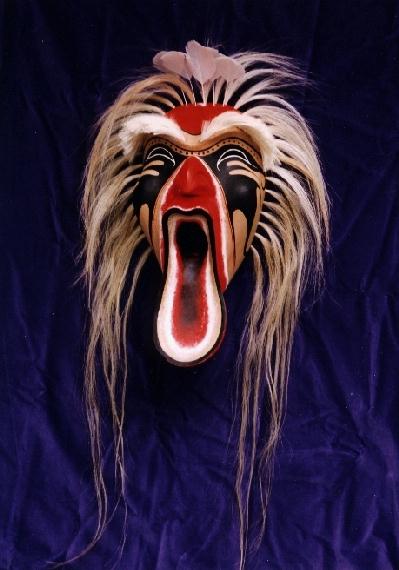
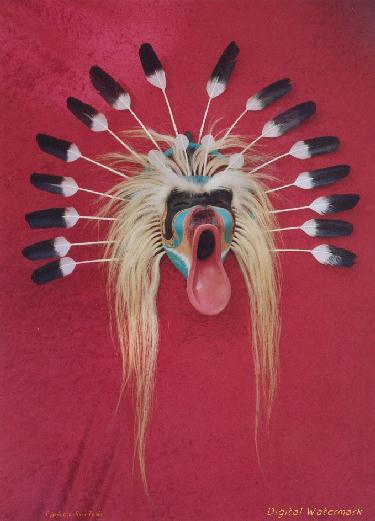
is an adoption mask. It's an Inuit man screaming. I got the idea
from an Indonesian mask, so if you subscribe to the theory of Inuit
people coming across the Pacific during the Ice Age, the
transformation is easy to recognize as far as bone structure, but
that's about all that's recognizable. Everything else on the mask
was done in collaboration with Art Thompson, who, in my mind, is one
of the most gifted carvers the planet has to offer. He is from the
West Coast, lives in Victoria, B.C., and has been carving for 37
years. I have just begun carving this particular type of mask with
him. It's an intensely personal mask, because I was adopted and
brutalized; so, if there's anyone else on this web site, Indigenous
or otherwise, who was unceremoniously uprooted and raised like an
animal, this mask is for all of you ... all of us! |
The Artist:
CLICK ON IMAGE TO VIEW FULL PHOTO
|
|
|
||
|
|
|
 Eric Schweig displays an Adoption Mask at the 1999 Great Mohican Gathering!
DON'T HAVE A REAL PLAYER TO VIEW THE FILE? DOWNLOAD ONE NOW FREE FROM REAL PLAYER!

| As far as any business dealings regarding my masks and other art goes, Mohican Press are, and as far as I can tell, always will be, on the up & up. We have a completely legitimate relationship. Certainly, they are not
ripping me off in any way, shape, or form. We have a fair business deal. In the future, to avoid any confusion, ALL persons seeking to market my art need to go through Mohican Press to validate any deal. Thank you! ... Eric Schweig, April 22, 1999 |
VISIT THE WEB SITE OF THE PHOTOGRAPHER WHO SHOT MANY OF THESE PHOTOS: Denis Poustka Photographer
ADOPTION SPEECH DELIVERED BY ERIC SCHWEIG || ADOPTION MASK RAFFLE RESULTS || ERIC SCHWEIG TALKS CARVING || ERIC SCHWEIG: AN INTERVIEW || 1992 ERIC SCHWEIG INTERVIEW




|
|